


BEST CHRONOGRAPH WATCHES FOR SMALLER WRISTS

Updated: Aug 16
| 20+ Great Chronographs Under 40mm
Welcome watchfans. As you may know, many watch types have a sizing problem, that often includes chronographs. Sound familiar. What should also be familiar is the fact that The Theowrist guides you and provides for you. So, here we have over 20 chronographs under 40m. Not 41mm, not 40mm, not even 39.9mm, 'cos that's just annoying, we start at 39mm.
Chronographs are cool, but the complication itself takes up space. Movements are larger, cases tend to be thicker, pushers add visual width and busy dials can make even a moderately sized watch look substantial. The result is a market full of chronographs measuring 41mm, 42mm and beyond. See my Raymond Weil Freelancer, for example, a pretty but rather chunky 42mm boy.

We smaller wristed folks do have to allow for such things. It's just one of many obstacles we face. That doesn't mean a smaller chronograph has to be vintage, quartz or compromised. There are excellent mechanical, automatic, hand-wound, solar and meca-quartz chronographs below 40mm, from relatively inexpensive watches through to some of the most important names in Swiss watchmaking.
For this guide, the cut-off is genuinely under 40mm. Remember, lug-to-lug, thickness, bezel proportions, dial opening and case shape all affect how a watch actually sits and fits.
Prices were checked in August 2026. Current watches use retail pricing where possible. Discontinued watches use representative current pre-owned ranges. Prices for brands selling internationally have been rounded into GBP or USD where necessary, so VAT, exchange rates and import charges can alter the final cost.
Quick math
Watch / Reference | Case size | Lug-to-lug |
Brew Metric Chronograph | 36 × 41.5mm | 41.5mm case length |
Brew Retrograph Chronograph | 38 × 41.5mm | 41.5mm case length |
Dan Henry 1964 Gran Turismo Chronograph | 38mm | 44.7mm |
Nezumi Tonnerre TQ2.102 | 38mm | 45.5mm |
Furlan Marri Castagna 1009-A | 38mm | ~46mm |
Baltic Bicompax 003 | 36.5mm | 46mm |
Timex Waterbury Heritage Chronograph TW2Y19200 | 39mm | 46mm |
MAEN Skymaster 38 MKIII M6.1.1 | 38mm | 47mm |
Baltic Tricompax / Scalegraph Classic | 39.5mm | 47mm |
Lorca Model No.2 Chronograph 8501 | 37mm case / 38mm bezel | 46mm |
Nivada Grenchen Chronomaster Aviator Sea Diver | 38.3mm | 46.6mm |
Hanhart 417 ES 1954 | 39mm | 46mm |
Sinn 356 Pilot | 38.5mm | ~46.5mm |
Omega Speedmaster Reduced 3510.50 | 39mm | ~44mm |
Omega Speedmaster 38 324.30.38.50.01.001 | 38mm | 44.9mm |
TAG Heuer Carrera Calibre 17 CV2111 | ~39mm | ~47mm |
TAG Heuer Carrera Glassbox CBS2210.BA0048 | 39mm | ~46mm |
Zenith Chronomaster Original 03.3200.3600/21.C903 | 38mm | ~46mm |
Kurono Tokyo Chronograph II | 38mm | ~46.5mm |
Seiko Prospex Speedtimer SSC813 | 39mm | 45.5mm |
Best affordable chronograph: Brew Metric
Best affordable mechanical chronograph: Baltic Bicompax 003, if you can find one
Best compact solar chronograph: Seiko Prospex Speedtimer SSC813
Best sub-£2,000 mechanical choice: Baltic Scalegraph Classic
Best pilot's chronograph: Hanhart 417 ES 1954
Best pre-owned buy: TAG Heuer Carrera CV2111
Best compact luxury: Omega Speedmaster Reduced for value, Speedmaster 38 if buying new
Best luxury chronograph: Zenith Chronomaster Original
Let's get into it then. We will split the offerings into 3 tiers by price, for those not in the UK, 'kinda' means 'kind of' or 'somewhat'.
TIER 1 | KINDA BARGAINS | SUB 500
Brew Metric Chronograph
Reference: Retro dial | Case size: 36 × 41.5mm | Thickness: 10.75mm | Lug-to-lug: 41.5mm case length | Movement: Seiko VK68 meca-quartz | Status: Current | Price: approx. £360 / $475
The Brew Metric is one of the clearest examples of why a smaller-wrist chronograph guide shouldn't be restricted to traditional round cases or expensive brands. Yes it hasa particular look, but I think it's a pretty great look, as do hundreds of watch fans.
Its 36mm width sounds extremely small for a chronograph, but the more useful figure is the 41.5mm overall case length. There aren't conventional projecting lugs, so almost the entire footprint remains inside that compact rectangular form. At 10.75mm thick, it is also substantially slimmer than most mechanical alternatives. Kooky placement for twin subdials works well but the date should have been at 3 to kill the dead space.

The Brew Metric is one of the clearest examples of why a smaller-wrist chronograph guide shouldn't be restricted to traditional round cases. Its 36mm width sounds extremely small for a chronograph, but the more useful figure is the 41.5mm overall case length. There aren't conventional projecting lugs, so almost the entire footprint remains inside that compact rectangular form. At 10.75mm thick, it is also substantially slimmer than most mechanical alternatives.
Brew uses Seiko's VK68 meca-quartz movement. Timekeeping is quartz, while the chronograph mechanism provides a more mechanical-feeling central seconds hand and reset action than a conventional quartz chronograph. That combination helps explain both the compact dimensions and relatively accessible price.
The Metric's integrated bracelet, strong dial geometry and seventies-influenced case give it a very different character from the numerous vintage racing chronographs elsewhere in this list. For a smaller wrist, the key attraction is simple: almost none of the nominal case dimensions are wasted on long lugs or a large external bezel.
Best for: Small wrists, design-led buyers and anyone who wants something noticeably different below £500.
Brew Retrograph Chronograph
Reference: N/A | Case size: 38 × 41.5mm | Thickness: 10.4mm | Lug-to-lug: 41.5mm case length | Movement: Hybrid meca-quartz chronograph | Status: Current | Price: approx. £285 / $375
The Retrograph is the more conventional-looking Brew, although conventional is relative here. The case measures 38mm across and just 41.5mm from top to bottom, with a thickness of 10.4mm. Again, that case length matters more than a traditional lug-to-lug measurement because of the lugless architecture. It produces a watch with noticeably less wrist coverage than most 38mm round chronographs. The espresso variation is used here as the other two colours are sold out.
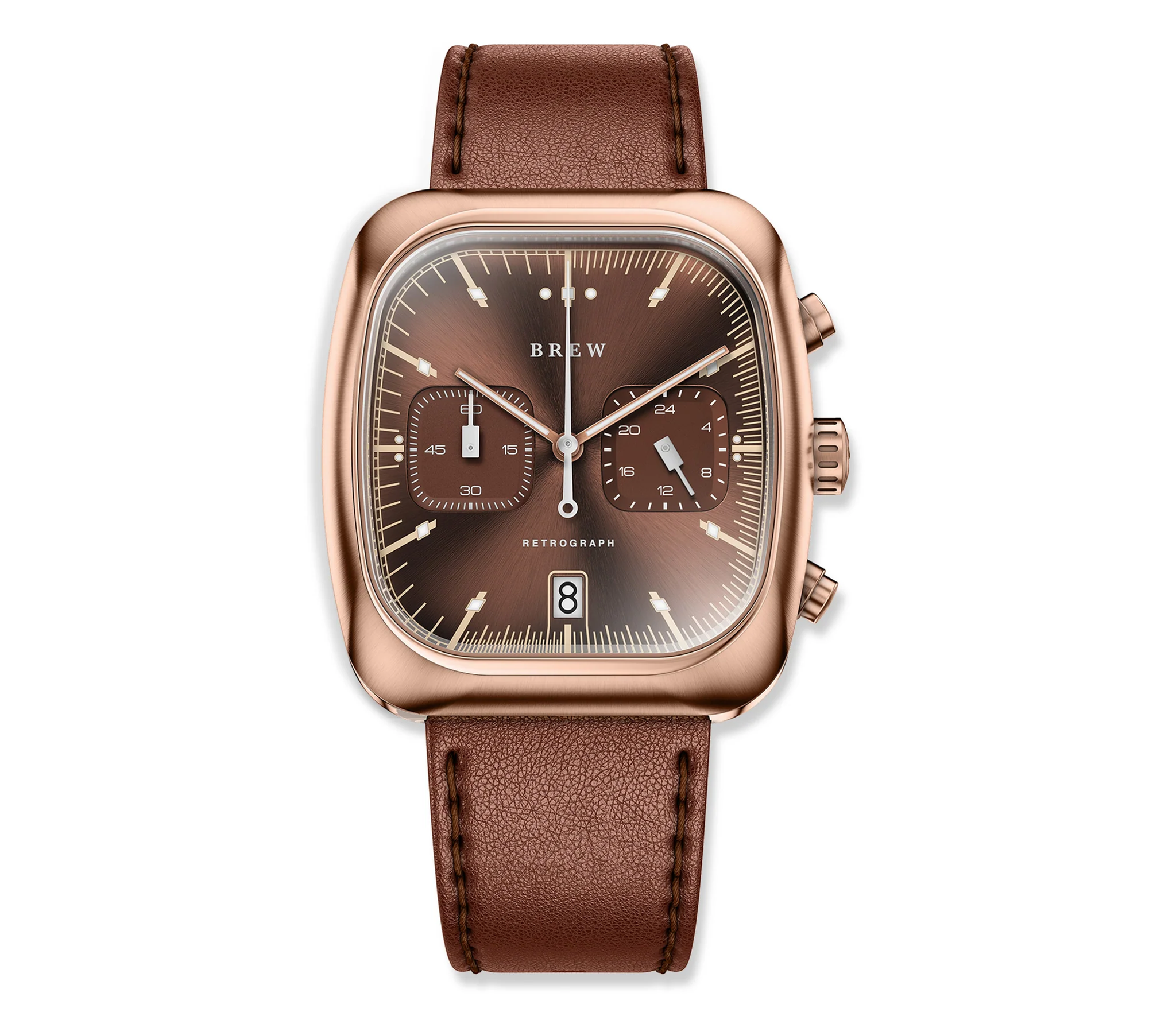
The movement is a hybrid meca-quartz chronograph, keeping the case thin and servicing relatively simple. The design itself is inspired by the visual language of industrial espresso machines and retains Brew's emphasis on timing the short intervals relevant to coffee extraction. Fair enough, they love coffee. So, do I, but I don't love the shape of the subdial hands.
It isn't trying to imitate a Swiss mechanical chronograph at a fraction of the price. That helps. The Retrograph has its own identity and, from a wearability perspective, is one of the least demanding watches here.
Best for: An affordable, slim chronograph with very little lug overhang.
Dan Henry 1964 Gran Turismo Chronograph
Reference: 1964 Gran Turismo | Case size: 38mm | Thickness: 12.9mm | Lug-to-lug: 44.7mm | Movement: Seiko VK63 meca-quartz | Status: Current | Price: approx. £215 / $280
The Dan Henry 1964 has been around long enough to demonstrate how sensible 38mm can be for a racing chronograph. They know what they're doing when comes to downsizing and providing value for money. There are tri-compax and bi-compax versions in various colour/date/no-date combos (2 or 3 subdials).

The 44.7mm lug-to-lug is the important figure. Combined with the 38mm diameter, it keeps the watch compact without shrinking the dial to the point where the sub-dials become difficult to read. Thickness is 12.9mm, so it has more vertical presence than the Brew watches, but not an unreasonable amount. I don't love the design but it hits the right marks for many people.
Inside is the familiar Seiko VK63 meca-quartz. That means quartz accuracy and affordability with a chronograph mechanism that feels more convincing at the pushers than a basic quartz unit.
There are more prestigious watches further down this list, but the Dan Henry gets the fundamentals right: compact proportions, recognisable mid-century motorsport styling and a price that makes it easy to recommend as an entry point into chronographs.
Best for: A traditional-looking chronograph on a limited budget.
ALSO : They do a 36mm in the same look. Marvellous.
Reference: 1964 Gran Turismo | Case size: 36mm | Thickness: 13.2mm | Lug-to-lug: 43.2mm | Movement: Seiko VK63 meca-quartz | Status: Current | Price: approx. £215 / $250
Dan Henry 1937 Dress Chronograph
Reference: 1937 Dress Chronograph | Case size: 38mm | Thickness: 12.7mm | Lug-to-lug: 46.1mm | Movement: Seiko VK64 meca-quartz chronograph | Status: Current, limited edition of 1,937 pieces | Price: approx. £220 / $290
Sticking with Mr Henry, we have the 1937 is a useful reminder that not every chronograph needs to look like it belongs at a racetrack. Its 38mm case, 46.1mm lug-to-lug and 12.7mm thickness give it genuinely compact proportions, while the sector-style dial, leaf-shaped hands and rectangular pushers push it towards the dressier end of the category. Dan Henry offers several dial layouts, including vertically and horizontally arranged sub-dials, with date and no-date versions.
Dan Henry 1937 Dress Chronograph Dan Henry 1937 Dress Chronograph
Inside is a Seiko VK64 meca-quartz movement, combining quartz timekeeping with a mechanically actuated chronograph module. That helps keep the price and case dimensions under control, and makes the 1937 considerably easier to own than a similarly styled vintage mechanical chronograph.
The 1937 works particularly well in this guide because it adds some variety. Most compact chronographs lean heavily into motorsport, aviation or tool-watch design. This one takes its cues from 1930s sector-dial chronographs and is much easier to wear with smarter clothing than the average tachymeter-bezel sports watch.
At around $290, it is also one of the least expensive watches here. The trade-off is obvious: it isn't mechanical, and the sapphire-coated K1 mineral crystal is less impressive on paper than a full sapphire crystal. But the dimensions are excellent and the design is unusually coherent for the price.
Best for: Someone who wants a compact chronograph with a dressier, pre-war aesthetic rather than another racing-inspired design.
Nezumi Tonnerre
Reference: TQ2.102 | Case size: 38mm | Thickness: 11.8mm | Lug-to-lug: 45.5mm | Movement: Seiko VK63 meca-quartz | Status: Current | Price: approx. £337 / $457
Nezumi's Tonnerre? Never heard of them, said I. Japanese name, Swedish design, assembled in Germany - sounds like a great combo. They sit in roughly the same broad category as the Dan Henry, but execution and detailing push it further upmarket. The case is 38mm across, 45.5mm lug-to-lug and 11.8mm thick. Those are particularly friendly dimensions for a chronograph because the watch retains a properly proportioned dial without acquiring the broad shoulders common to larger racing watches. It also looks fantastic, the colour and design cues are top notch.
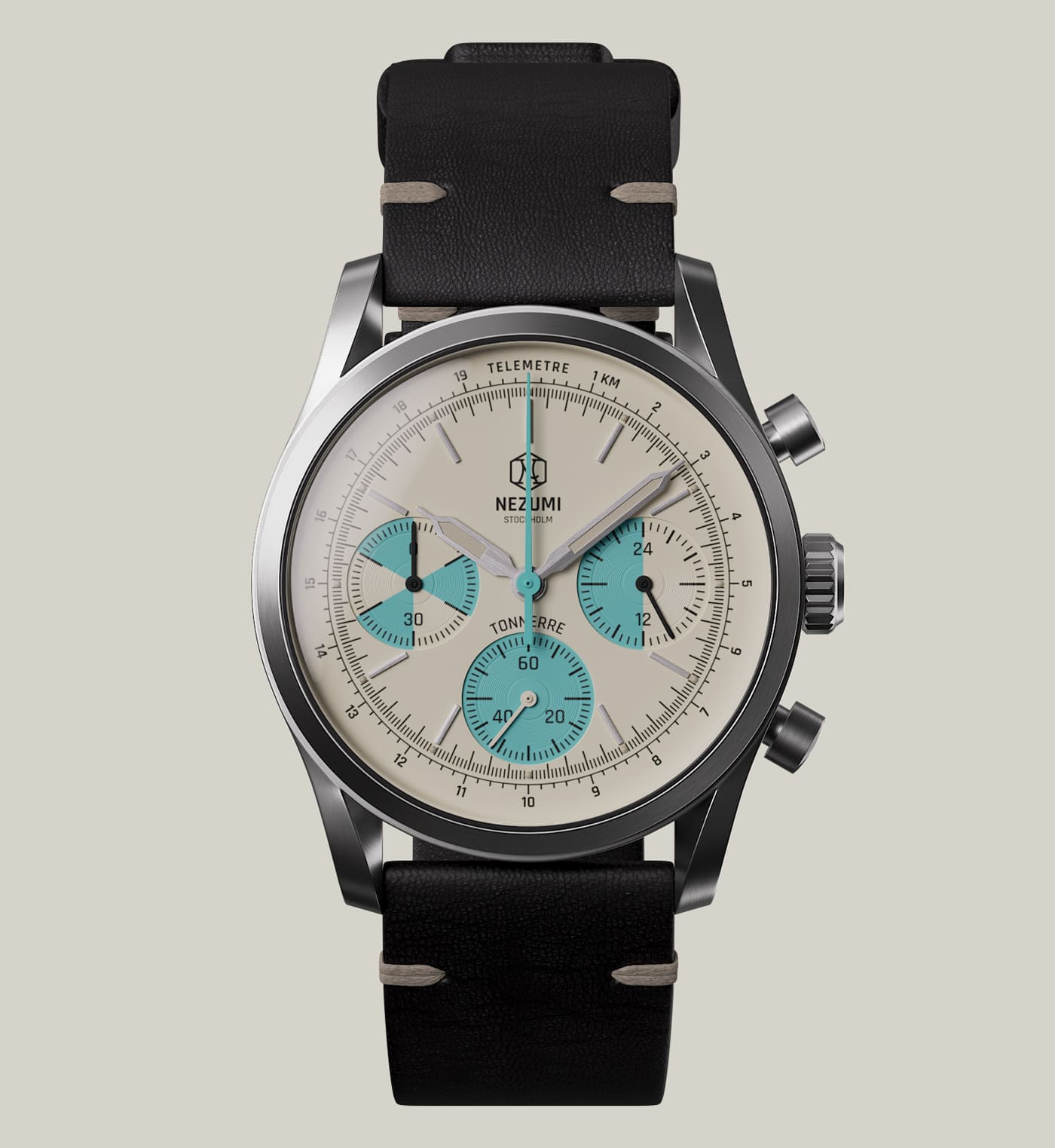
As is common for chrono's at this size and budget, it uses the Seiko VK63 meca-quartz movement. That limits mechanical romance, but it also allows Nezumi to keep the case comparatively thin while providing a reliable chronograph at a sensible price.
The Tonnerre's attraction is really its balance. It has enough vintage motorsport influence to be immediately recognisable without becoming an outright recreation of one historic watch. The short case and restrained thickness also mean the 38mm measurement translates honestly to the wrist.
Best for: Buyers who like vintage racing design but want something more distinctive than the obvious alternatives.
Furlan Marri Castagna
Reference: 1009-A | Case size: 38mm | Thickness: 11.5mm case, approx. 12mm including crystal | Lug-to-lug: 46mm | Movement: Seiko VK64 meca-quartz | Status: Current | Price: £538 / approx. $725
Furlan Marri built much of its early reputation around getting the exterior details of a vintage chronograph unusually right. and it nailed it, so much hype, so much reselling. Things have settled and you can buy one from the website these days, thank the lords. They offer a number of design option, including bicompax and single subdial, which I want to call compax but I won't.
Furlan Marri Castagna Furlan Marri Castagna
The Castagna measures 38mm across and 46mm lug-to-lug, with an 11.5mm case that reaches roughly 12mm once the crystal is included. It is therefore slightly longer than the Nezumi and Dan Henry, but still firmly within compact chronograph territory.
Power comes from Seiko's VK64 meca-quartz calibre. At this price, some buyers will understandably want a fully mechanical movement. The counterargument is that much of the money has gone into the case, dial, finishing and proportions rather than an inexpensive mechanical chronograph calibre. That distinction matters. It looks fantastic. The Castagna isn't the cheapest way to acquire a meca-quartz chronograph. It is one of the more carefully resolved watches built around one.
Best for: Buyers who prioritise case design, dial detail and vintage proportions over having a fully mechanical movement.
Timex Waterbury Heritage Chronograph
Reference: TW2Y19200 | Case size: 39mm | Thickness: 13.5mm | Lug-to-lug: 46mm | Movement: Meca-quartz chronograph | Status: Current model family, reference availability varies | Price: approx. £275 / $359
IMAGE: Timex Waterbury Heritage Chronograph official galleryhttps://timex.com/collections/waterbury-heritage-chronograph
The Waterbury Heritage Chronograph is one of the larger-looking watches in this guide, but its dimensions remain sensible. The case is 39mm with a 46mm lug-to-lug. At 13.5mm thick, it isn't especially slim, although the combination of restrained diameter and compact lug span prevents it becoming cumbersome.

Timex uses a meca-quartz chronograph arrangement here. The broader Waterbury Heritage Chronograph range remains current in the US, with bracelet models listed at $359, although individual references and colours move in and out of stock. The appeal is straightforward. You get a recognisable steel sports-chronograph format, a proper bracelet option and dimensions that don't assume everyone wants a 42mm case.
Best for: A mainstream, easy-to-buy compact chronograph with a bracelet.
TIER 2 | KINDA PRICEY | 500 - 2000
MAEN Skymaster 38 MKIII
Reference: M6.1.1 | Case size: 38mm | Thickness: 13.4mm | Lug-to-lug: 47mm | Movement: Sellita SW510Mb Top Grade, manual wind | Status: Current | Price: approx. £1,450 / $1,950
The Skymaster 38 is where this list starts moving into more serious Swiss mechanical chronograph territory. I'll be honest, I was initially surprised by the price. I thought it would be closer to the £1000 mark. It's the hardware that sets it apart thought. The 38mm case is paired with a 47mm lug-to-lug and 13.4mm thickness. That makes it longer than the Brew, Dan Henry and Hanhart, although still well controlled for a watch built around a full mechanical chronograph movement. Remember that thick rubber straps can help larger cases with the transition to the wrist.

The current MKIII was redesigned around the Top Grade Sellita SW510Mb, a manually wound movement with roughly 56 to 62 hours of power reserve depending on specification. MAEN also increased water resistance to 100 metres.
This is worth noting because compact mechanical chronographs often force a choice between dimensions, movement quality and everyday practicality. The Skymaster manages those competing requirements rather well.
The 47mm length means very small wrists should still try one first. For most wrists that find 41mm and 42mm chronographs excessive, however, the 38mm case is a meaningful improvement.
Best for: A modern Swiss mechanical chronograph under the £2,000 mark.
Baltic Bicompax 003
Reference: Bicompax 003 | Case size: 36.5mm | Thickness: 13mm including crystal, 10mm without | Lug-to-lug: 46mm | Movement: Seagull ST1901 manual-wind mechanical chronograph | Status: Discontinued | Price: typically £550–£750+ / $700–$950+ pre-owned
Baltic are legends in the microbrand space, so much so that they aren't so micro no more. They were one of the first to leverage the Chinese ST1901 movement and make it there own. The Bicompax 003 is the smallest conventional round watch in this guide at 36.5mm.
That number needs context. Its 46mm lug-to-lug is relatively long compared with the diameter, so it doesn't wear like a tiny 36mm dress watch. The combination actually works well for a chronograph: a compact central case, enough wrist presence to prevent the dial feeling undersized, and plenty of room for the two-register layout. The execution is beautiful.

The hand-wound Seagull ST1901 is based on the architecture descended from the Swiss Venus 175 tooling acquired by Tianjin in the 1960s. It gives the Bicompax a genuinely mechanical chronograph movement without moving into Swiss chronograph pricing.
Baltic has since moved on from the Bicompax 003, and its archive places the model among its discontinued collections. That means availability now depends on the secondary market.
For smaller wrists, it remains one of the strongest compact mechanical chronographs Baltic has produced.
Best for: A genuinely small, manually wound mechanical chronograph at sensible used prices.
Baltic Scalegraph Classic
Reference: Scalegraph Classic Panda | Case size: 39.5mm | Thickness: 13.5mm including crystal, 11mm without | Lug-to-lug: 47mm | Movement: Sellita SW510-M manual-wind | Status: Current | Price: approx. £1,450 / $1,800
The Scalegraph is the current Baltic to consider if you liked the idea of the old Tricompax but want something still in production. At 39.5mm it comes very close to our 40mm limit, but the 47mm lug-to-lug keeps it controlled. Thickness is 13.5mm including the domed crystal, while the underlying case itself measures around 11mm.

The major attraction is the movement. Baltic uses the hand-wound Sellita SW510-M, giving the Scalegraph a Swiss mechanical chronograph calibre rather than the ST1901 found in the less expensive Bicompax. The current Classic versions start at around €1,585 depending on configuration, placing the Scalegraph in an interesting part of the market: materially more expensive than Baltic's earlier Chinese-movement chronographs, but still well below most comparable Swiss-brand mechanical chronographs.
Because the dial runs close to the edge of the case, it has more visual presence than a 39.5mm watch with a broad bezel. The short enough lug span keeps that from becoming a problem on most smaller wrists. As Baltic move to more estalbished movements, the prices creep up and competition heats up. They do a great job though, of keeping their offerings looking special.
Best for: A traditional manual-wind Swiss chronograph without traditional Swiss-brand pricing.
Lorca Model No.2 Chronograph
Reference: 8501 series | Case size: 37mm case, 38mm bezel | Thickness: 14.1mm including crystal, 11.6mm case | Lug-to-lug: 46mm | Movement: Sellita SW510 M manual-wind | Status: Current, availability/pre-order varies by dial | Price: approx. £2,100 / $2,750
Never heard of Lorca? You're not the only one. A US based, Swiss made brand, it's got style for miles. Lorca's Model No.2 is one of the most compact fully mechanical watches here in terms of its basic footprint. The case itself is 37mm, while the bezel extends to 38mm. Lug-to-lug is 46mm. The 14.1mm total thickness sounds substantial, but that includes the crystal; the underlying case is around 11.6mm.

Inside is a manually wound Sellita SW510 M with around 63 hours of power reserve. The watch is also rated to 100 metres, giving it more everyday practicality than the vintage aesthetic initially suggests.
The Model No.2 is not cheap. At $2,750 it sits above several established European brands, so the case for buying one rests on its unusually compact proportions, thoughtful design and low-volume nature rather than obvious value by specification alone. Just look at the end links, they sit flush with the case, the bracelet has it's own charm and the bezel is fabulous - I want to touch it. For a wrist that finds even a 39mm chronograph visually large, however, there aren't many modern mechanical alternatives this compact.
Best for: Buyers specifically looking for a sub-39mm Swiss mechanical chronograph with independent-brand design.
Nivada Grenchen Chronomaster Aviator Sea Diver
Reference: Chronomaster 86015M03LC | Case size: approx. 38mm | Thickness: approx. 13.75mm | Lug-to-lug: approx. 46.5mm | Movement: Sellita SW510 M BH B manual-wind | Status: Current | Price: from approx. £1,910 / $2,585
Nivada Grenchen as a brand have been around but they exploded back on the scene after releaunch in 2020. They continue to do their own thing, apologising to absolutely nobody.

Few watches in this guide combine quite as much functionality and super style with a relatively small case. The Chronomaster Aviator Sea Diver dates conceptually to Nivada's multifunction chronographs of the early 1960s. The modern collection retains the rotating bezel, chronograph, tachymeter and regatta-related functionality that made the original unusually versatile. Nivada currently offers 38mm versions from $2,085.
The range is extensive, and specifications vary between automatic and hand-wound versions. For this guide, the hand-wound 38mm models are the cleaner fit, using the Sellita SW510 M BH B. Nivada documents the manual calibre across the current CASD range.
The dial and bezel are busy, which means this isn't a chronograph that visually disappears on the wrist. Physically, though, the roughly 38mm case and mid-46mm lug span make it considerably more manageable than many modern tool chronographs.
Best for: Vintage tool-watch character and genuine historical context in a modern compact chronograph.
Nivada Grenchen Chronomaster Broad Arrow
Reference: 86056M01LC | Case size: 38mm | Thickness: 14.55mm | Lug-to-lug: not officially stated | Movement: Landeron 70 manual-wind mechanical chronograph | Status: Current | Price: approx. £1,910 / $2,585
The Chronomaster Broad Arrow is one of the more unusual compact mechanical chronographs in the current Nivada Grenchen range. Its 38mm stainless-steel case keeps the basic footprint suitably restrained, although the 14.55mm thickness gives it considerably more presence than the diameter alone suggests. Nivada does not publish a lug-to-lug figure for this reference, so that is one measurement I would not invent for the sake of completing the spec sheet. The case uses 20mm lugs and is rated to 100 metres of water resistance. This is one of my favourites on the list, the design is aggressive and unapologetic, but well balanced.

Inside is the Landeron 70, a manually wound mechanical chronograph movement. That helps distinguish the Broad Arrow from the numerous meca-quartz options at the affordable end of this guide and gives it a more traditional relationship with the chronographs that inspired it. The watch takes its name from the prominent broad-arrow hour hand, with a matte black dial, cream-coloured luminous markers and matching aged-tone lume on the hands. A double-domed sapphire crystal adds further vintage character without requiring the compromises of acrylic.
The more unusual feature is the tool-free interchangeable bezel system. Nivada supplies five bezels with the watch, allowing the appearance and functionality to be changed by hand. The system revives an idea the brand previously used on its 1960s Colorama VI collection, although here it is applied to a much more functional sports chronograph.
At $2,585 on strap, equivalent to roughly £1,910 at current exchange rates, it sits in a competitive part of the mechanical chronograph market. Bracelet configurations cost more. The attraction isn't simply value, though. Few current watches combine a 38mm case, hand-wound mechanical chronograph movement, 100m water resistance and this degree of visual customisation.
The only real sizing caveat is thickness. It is compact across the wrist, but not particularly slim, so buyers looking for something that disappears beneath a cuff should look elsewhere (Hannhart 417 ES). They do have mechaquartz (Chronoking) versions at 13.4mm thick, it's also one thousand pounds cheaper. And Prefer the Hanhart 417 ES or one of the thinner quartz options. They also do a mech
Best for: A compact hand-wound mechanical chronograph with vintage Nivada character and unusually flexible bezel options.
Seiko Prospex Speedtimer SSC813
Reference: SSC813 / SSC813P1 | Case size: 39mm | Thickness: 13.3mm | Lug-to-lug: 45.5mm | Movement: Seiko V192 solar quartz chronograph | Status: Current | Price: £640 / $680
The SSC813 has become an obvious recommendation in compact chronograph discussions for good reason. The 39mm case is only part of it. Lug-to-lug is a particularly tidy 45.5mm, so it occupies very little wrist length for a sports chronograph. Thickness is 13.3mm, which gives it some presence without pushing it into the proportions of a large automatic chronograph.
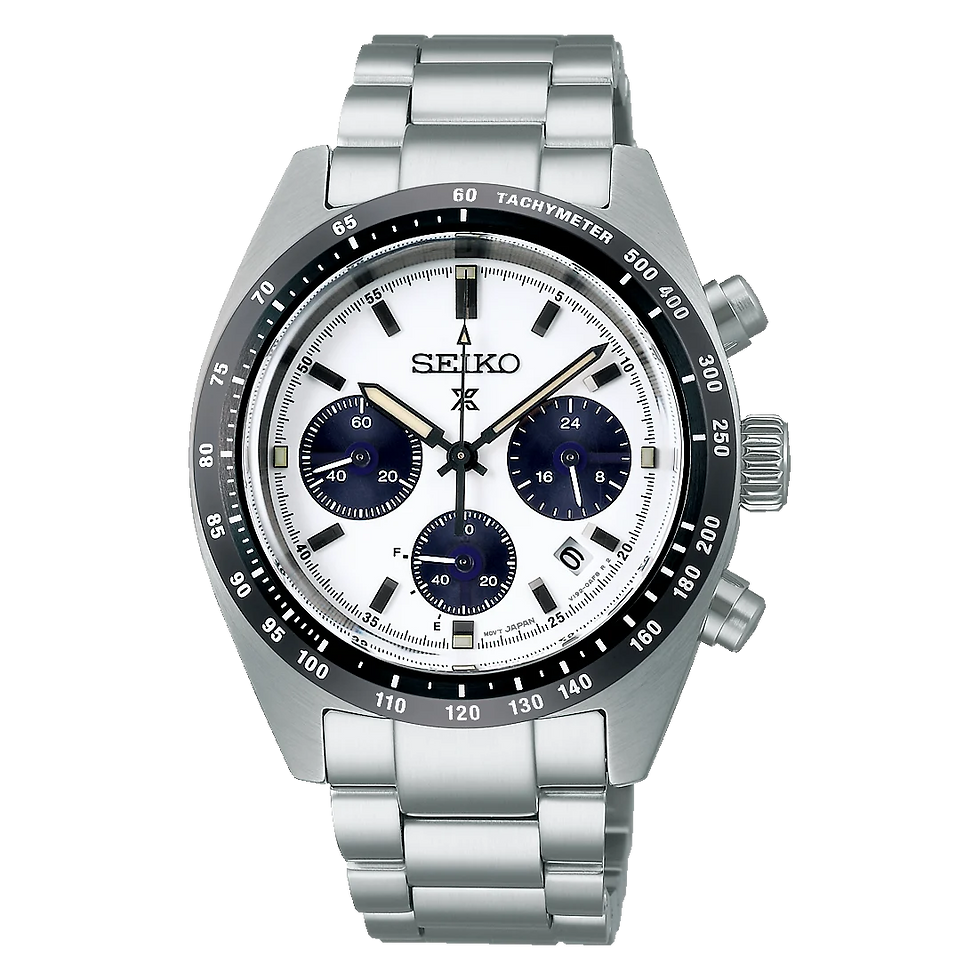
The V192 solar quartz movement removes the need for routine battery changes while offering chronograph timing, a 24-hour indicator and power-reserve functionality.
It is also one of the few watches here that combines a compact case with a steel bracelet, sapphire crystal, 100 metres of water resistance and genuine mainstream availability.
The dial is visually busy and the bezel increases its apparent diameter, so it won't look as small as a 39mm dress watch. That isn't really the point. Compared with most modern sports chronographs, the SSC813 has excellent proportions and very little unnecessary case.
Best for: The easiest all-round recommendation below £1,000.
TIER 3 | KINDA LUXURY | 2000+
Tudor Black Bay Chrono 39
Reference: M79310N-0001 | Case size: 39mm | Thickness: 13.1mm | Lug-to-lug: 47mm | Movement: Tudor Manufacture Calibre MT5813 automatic chronograph | Status: Current | Price: approx. £5,300 / $6,790
The Black Bay Chrono 39 is the compact Tudor chronograph enthusiasts had been asking for. Introduced in 2026, it reduces the Black Bay Chrono formula to a 39mm case with a 47mm lug-to-lug and 13.1mm thickness. That is a meaningful change from the larger 41mm Black Bay Chrono, particularly for wrists where the combination of broad case, fixed tachymeter bezel and screw-down pushers can make a chronograph feel larger than its stated diameter. Reference M79310N-0001 uses a yellow dial with black sub-dials, a black anodised aluminium tachymeter bezel and a three-link steel bracelet with Tudor's T-fit rapid-adjustment clasp. It's hard to miss.

The proportions are especially useful because Tudor hasn't simply reduced the diameter while leaving excessively long lugs behind. A 47mm overall length puts it in broadly the same compact territory as watches such as the Baltic Scalegraph and MAEN Skymaster 38, while retaining 200 metres of water resistance and a substantial steel sports-watch construction.
Inside is Tudor's MT5813, a COSC-certified automatic chronograph calibre with a column wheel, vertical clutch and approximately 70 hours of power reserve. The movement is based on Breitling's B01 architecture and has long been one of the strongest technical arguments for the Black Bay Chrono family.
That colour scheme will determine whether some buyers get any further than the photographs, but the more important development is the case itself. Tudor now has a modern mechanical chronograph below 40mm with strong water resistance, a serious integrated chronograph calibre and proportions that genuinely suit smaller wrists.
At roughly £5,300 / $6,790 at retail-equivalent pricing, it lands between watches such as the Hanhart 417 ES and the more expensive TAG Heuer Carrera Glassbox or Zenith Chronomaster Original.
For this guide, it deserves a place near the top of the luxury options simply because there are very few current automatic chronographs combining a 39mm case, 47mm lug-to-lug, 200m water resistance and this level of movement specification.
Best for: A robust luxury chronograph with genuinely compact proportions and stronger everyday specifications than most traditional racing chronographs.
Hanhart 417 ES 1954
Reference: 417 ES 1954 39mm | Case size: 39mm | Thickness: approx. 13.3mm | Lug-to-lug: 46mm | Movement: Sellita SW510 manual-wind mechanical chronograph | Status: Current | Price: approx. £2,000–£2,200 / $2,500–$2,700 depending on configuration
We start the pricey tier with Hanhart. Not a brand I am super familiar with but they do good work. The 417 ES 1954 is one of the easiest watches here to recommend on proportions alone. Hanhart deliberately returned the modern 417 to the 39mm size of the historical model. The case is paired with a short 46mm lug-to-lug, giving it less wrist coverage than several nominally smaller watches.
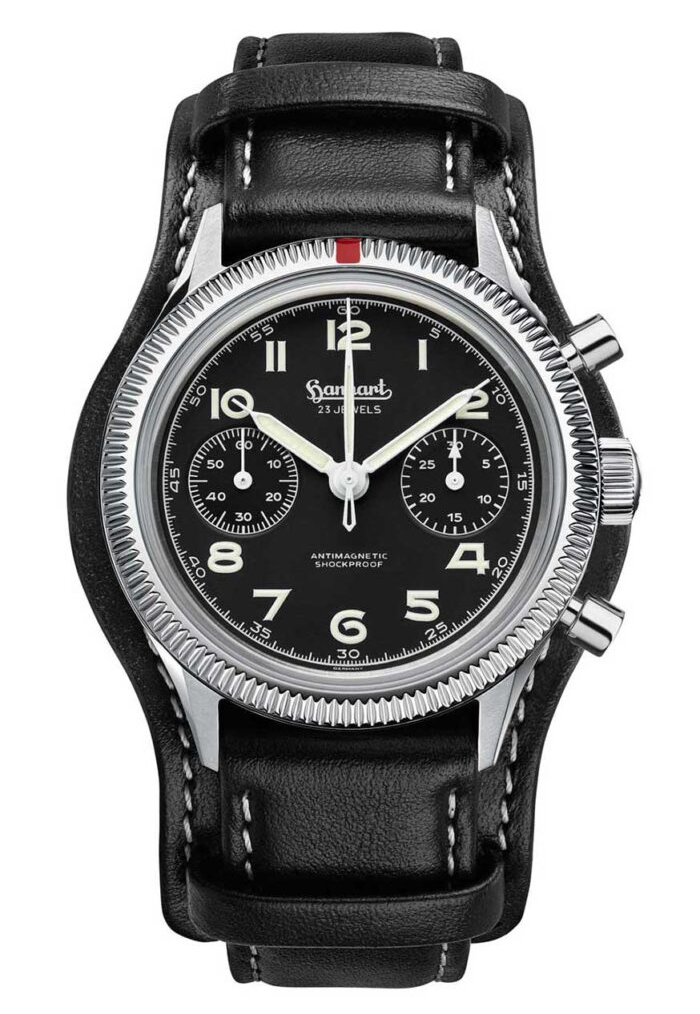
The current non-flyback 417 ES uses a hand-wound Sellita SW510-based movement. Hanhart also offers more expensive flyback versions using its AMT5100 M column-wheel calibre; those retain the same basic 39mm by 46mm proportions and measure 13.3mm including the crystal.
The rotating fluted bezel adds visual width, but because the dial itself isn't oversized the watch remains balanced. This is also one of those cases where the smaller diameter isn't simply a concession to modern demand. It restores the proportions of Hanhart's original 1950s chronograph.
Best for: A compact pilot's chronograph with meaningful historical continuity.
Sinn 356 Pilot
Reference: 356 Pilot | Case size: 38.5mm | Thickness: 15.5mm | Lug-to-lug: approx. 46mm | Movement: Automatic mechanical chronograph | Status: Current | Price: from about £2,090 / approx. $2,650
The Sinn 356 demonstrates why diameter alone is a poor way to judge chronograph wearability. Its 38.5mm case and roughly 46mm lug-to-lug are excellent for smaller wrists. The compromise is thickness. At around 15.5mm, the 356 is one of the tallest watches in this guide. Independent measurements put the lug-to-lug at around 46mm, with much of the visual height coming from the domed crystal and automatic chronograph architecture.
That means it wears compactly across the wrist but not discreetly.

For the right buyer, that is entirely acceptable. The 356 is a functional pilot's chronograph with a clear dial, strong case construction and the recognisable layout associated with automatic 7750-family chronographs. If your main problem with chronographs is overhanging lugs, the Sinn solves it. If your problem is getting a watch underneath a tight shirt cuff, there are better options elsewhere on this list.
Best for: Smaller wrists that want Pilot style don't mind thickness and want a serious automatic tool chronograph.
Omega Speedmaster Reduced
Reference: 3510.50 / 3510.50.00 | Case size: 39mm | Thickness: approx. 12mm | Lug-to-lug: approx. 44.5mm | Movement: Omega calibre 3220 automatic modular chronograph | Status: Discontinued | Price: typically £2,300–£3,300 / $3,000–$4,200 pre-owned
The Speedmaster Reduced is not simply a smaller Moonwatch. That distinction is important. The 3510.50 uses an automatic modular chronograph movement rather than the hand-wound architecture of the Speedmaster Professional. Omega calibre 3220 combines an ETA-derived automatic base with a Dubois-Dépraz chronograph module.

What it does offer is an extremely useful set of dimensions: approximately 39mm across, around 44.5mm lug-to-lug and roughly 12mm thick depending on measurement method. That gives it one of the shortest conventional case footprints in this entire guide.
The Reduced was discontinued after a production run stretching from the late 1980s into the 2000s. Prices have risen from the days when it was treated mainly as the cheaper Speedmaster, but it remains significantly less expensive than many new Omega chronographs.
Servicing deserves attention. The modular movement is more involved than a simple three-hand automatic, so a cheap example with no service history can quickly become less cheap.
Best for: A genuinely compact pre-owned Speedmaster, provided condition and servicing are checked properly.
Omega Speedmaster 38
Reference: 324.30.38.50.01.001 | Case size: 38mm | Thickness: approx. 14.7mm | Lug-to-lug: 44.9mm | Movement: Omega calibre 3330 Co-Axial automatic chronograph | Status: Current | Price: around £6,300 / approximately $6,500–$7,000
I nearly bought one of these a million years ago, but I didn't. Fact. Anyway, the current Speedmaster 38 is physically shorter across the wrist than its name might suggest. A 44.9mm lug-to-lug is excellent for a mechanical chronograph and shorter than many 36mm and 37mm watches with traditionally extended lugs. The main compromise is again thickness: at roughly 14.7mm, this isn't a particularly slim 38mm watch.

Inside is Omega's calibre 3330, an automatic Co-Axial chronograph movement. The dial arrangement, date window and oval sub-dials also give the Speedmaster 38 its own identity rather than simply reducing the dimensions of the Moonwatch.
That is either a strength or weakness depending on what you're looking for. Buyers who want a miniature Speedmaster Professional may still prefer the discontinued Reduced. Buyers who want a current Omega chronograph with strong specifications, modern finishing and an impressively short case should look at the 38.
UK retail for steel examples is around £6,300 at current authorised retailers.
Best for: A modern luxury chronograph for a wrist that struggles with the standard Speedmaster Professional.
TAG Heuer Carrera Calibre 17
Reference: CV2111 / CV2111-0 | Case size: approx. 39mm | Thickness: approx. 13.5mm | Lug-to-lug: approx. 47mm | Movement: TAG Heuer Calibre 17 automatic chronograph | Status: Discontinued | Price: typically £1,900–£2,900 / $2,500–$3,700 pre-owned
The CV2111-era Carrera is one of the better arguments for looking backwards when shopping for a compact chronograph. At roughly 39mm, it predates the period when the Carrera expanded into numerous 41mm, 43mm and larger references. The case is around 13.5mm thick and approximately 47mm lug-to-lug, giving it a traditional but still very wearable shape.

The movement is TAG Heuer's automatic Calibre 17. The clean three-register layout, restrained bezel and relatively open dial give the watch plenty of visual presence without requiring a large case.
Current pre-owned prices vary considerably with condition, strap or bracelet, box and papers. Recent UK examples have appeared from just under £1,900 to around £2,850 for strong full-set watches. That can make the CV2111 particularly compelling beside new luxury chronographs costing considerably more.
Best for: A pre-owned Swiss chronograph with classic Carrera proportions and strong value.
TAG Heuer Carrera Chronograph Glassbox
Reference: CBS2210.BA0048 | Case size: 39mm | Thickness: 13.9mm | Lug-to-lug: approx. 46mm | Movement: TAG Heuer TH20-00 automatic chronograph | Status: Current | Price: £6,400 / $7,550
The modern Carrera Glassbox proves that TAG Heuer can still make a chronograph without making the case unnecessarily large. The case is 39mm across and 13.9mm thick. The roughly 46mm end-to-end length is particularly good, helped by compact lugs that curve quickly away from the case.
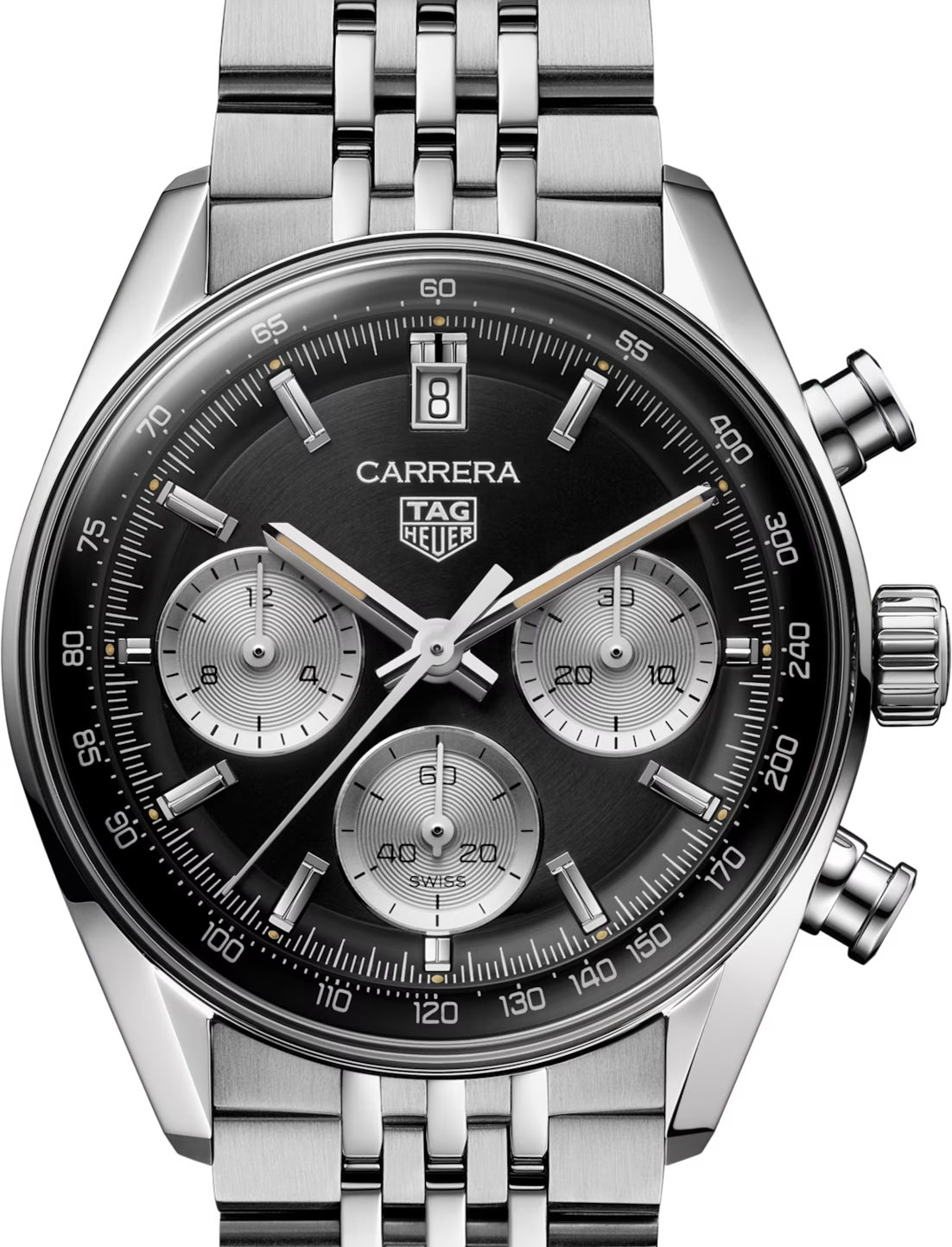
The design's defining feature is the domed sapphire crystal, which extends over the curved dial flange and recreates some of the depth associated with vintage acrylic Carreras without actually using acrylic. Another prominent feature, that I don't usually like, is a date at 12, but they make it work.
Inside is the in-house TH20-00, an automatic chronograph with an 80-hour power reserve. TAG Heuer currently lists the bracelet reference CBS2210.BA0048 at $7,550 in the US and £6,400 in the UK. It is substantially more expensive than the discontinued CV2111, but it also delivers a modern movement, current warranty, better water resistance and a case that preserves much of the Carrera's traditional compactness.
Best for: A current luxury Carrera that still respects the proportions that made the original work.
Zenith Chronomaster Original
Reference: 03.3200.3600/21.C903 | Case size: 38mm | Thickness: approx. 12.9mm | Lug-to-lug: 46mm | Movement: El Primero 3600 automatic, 5Hz | Status: Current | Price: approx. £8,500–£9,000 / $10,600
If price isn't the main constraint, the Chronomaster Original is arguably the benchmark in this list. In 1969 Zenith invented the automatic movement with chronograph as you know it. Even Rolex used them until the year 2000. It's got history. The 38mm case deliberately references the proportions of Zenith's A386 from 1969. Lug-to-lug is about 46mm and thickness roughly 12.9mm, which is impressively restrained given what sits inside.
Zenith Chronomaster Origina Zenith Chronomaster Origina
The El Primero 3600 runs at 36,000 vibrations per hour, or 5Hz, allowing the chronograph seconds hand to make one complete revolution every ten seconds and display elapsed tenths of a second against the outer scale. The movement also offers around 60 hours of power reserve.
This is not a reduced version of a larger watch. The 38mm case is central to the Chronomaster Original's historical argument and one reason the design feels so coherent.
Its reverse-panda reference 03.3200.3600/21.C903 currently sits above £8,000 at retail-equivalent pricing, although unworn and pre-owned examples can be found materially below list. My only issues with it is that it should have the date at 6 (instead of 4:30), and the Zenith star on the chronograph hand like the 42mm version.
Best for: The strongest combination of serious chronograph movement, history and compact dimensions.
Kurono Tokyo Chronograph II
Reference: Chronograph II Black / Shiro | Case size: 38mm | Thickness: 13.9mm | Lug-to-lug: approx. 46.5mm | Movement: NE86 automatic column-wheel chronograph | Status: Sold out / discontinued limited edition | Price: roughly £3,300–£3,700 / $4,000–$4,600 on the secondary market
The Kurono Chronograph II brings something different to the group. Wait, you think it looks like the Furlan Marri Castagna. It does. They both have the the multi-toned sector ring, the leaf hands, and the prominent outer medical scales - the OG boss they are inspired by is the Patek Philippe ref 1463 (Tasti Tondi). Anyway, its 38mm polished case is paired with an independently measured lug-to-lug of roughly 46.5mm and an official thickness of 13.9mm including the high-curvature sapphire crystal. Kurono produced the Chronograph II in a limited run of 500 pieces.

Inside is the Japanese NE86, an automatic column-wheel chronograph calibre running at 28,800 vibrations per hour with around 45 hours of power reserve. The dial is where much of the appeal lies. Kurono's typography, scales and hand shapes reference mid-century chronographs without simply reproducing a familiar Swiss design.
Availability is now the problem. The model is sold out, and secondary-market asking prices can exceed the original retail price substantially. A recent Chronograph II Shiro listing was around $4,500. It belongs in this guide because there are relatively few Japanese mechanical chronographs combining this level of movement specification with a 38mm case. Oh and it's gorgeous..
Best for: Collectors looking for a compact Japanese mechanical chronograph rather than
another Swiss-inspired alternative.
Breguet Classique Chronograph 3230
Reference: 3230 | Case size: 36mm | Thickness: approx. 10mm | Lug-to-lug: approx. 44mm | Movement: Breguet calibre 533, based on the Lemania 2310, manual-wind column-wheel chronograph | Status: Discontinued / neo-vintage | Price: typically around £20,000–£30,000 / $25,000–$38,000 depending on condition, metal and provenance
The Breguet Classique Chronograph 3230 is a neo-vintage beauty. Introduced in the 1980s, the 3230 comes from the period when Daniel Roth was helping rebuild Breguet's identity around the historic design language of Abraham-Louis Breguet. The result is a chronograph that looks unmistakably classical without feeling like a costume piece. Its 36mm case, roughly 44mm lug-to-lug and approximately 10mm thickness are especially striking now, when mechanical chronographs routinely exceed 40mm and 13mm thick.
The case is traditionally proportioned, with straight lugs, a polished bezel and Breguet's familiar finely fluted caseband. Most examples are found in yellow or rose gold, paired with a silvered guilloché dial, Roman numerals and blued pomme hands. The chronograph layout is restrained, using two sub-dials rather than filling every available millimetre with additional scales and registers.

Inside is the manually wound Breguet calibre 533, developed from the Lemania 2310 architecture. The underlying CH27 family was created by Albert Piguet at Lemania and became one of the most respected hand-wound chronograph bases of the twentieth century.
From a smaller-wrist perspective, the 3230 is wildly well proportioned by modern standards. A 36mm diameter sounds like dress-watch territory, yet the long straight lugs extend the watch to roughly 44mm overall, giving it enough wrist presence to avoid feeling delicate. If you want to call it a dress chronograph, I'll allow it. At only around 10mm thick, it is also substantially slimmer than almost every current mechanical chronograph in this article.
The downside is price and availability. The 3230 is discontinued and increasingly regarded as an important piece of modern Breguet history. Current asking prices can sit around £20,000 to £30,000, with particularly strong examples, early watches, complete sets and unusual configurations asking more. It is therefore not the obvious value choice in this guide. It is here because very few chronographs combine this level of horological credibility, hand-finished traditional design and genuinely compact proportions.
Best for: A collector who wants a genuinely compact high-end mechanical chronograph with strong movement pedigree, restrained proportions and important neo-vintage Breguet context.
Tier X | KINDA UNOBTAINABLE | 200,000+
Patek Philippe Ref. 1463 “Tasti Tondi”
Reference: 1463 | Case size: 35mm | Thickness: not reliably published for this example | Lug-to-lug: not reliably published | Movement: Patek Philippe calibre 13'''-130 manual-wind chronograph | Status: Discontinued / vintage | Price: £201,231 / €230,000 / $271,449 asking price for this 1946 example
I've been into Patek recently (AD visit article incoming). Until then I'm dropping a coupld of insanely compact beauties in here. This is the 'Tasti Tondi' translated as 'Round Pushers' in Italian- the godfather of the Furlan Marri, Kurono Tokyo and many more. The Patek Philippe Ref. 1463 is one of the most historically important watches in this guide, and one of the smallest. Introduced around 1940, the 1463 was Patek Philippe's first water-resistant chronograph wristwatch, using a screw-down caseback and distinctive round chronograph pushers. Patek itself identifies the 1463 as an important water-resistant chronograph in its historical material, while major auction houses consistently document the same significance.
The example linked here dates from 1946, with the seller describing it as a 1946/47 watch in 18-carat yellow gold. It measures just 35mm across, with a plexiglass crystal, ivory dial and leather strap. Eyeballing this one, my expert eye says the lug-to-lug is no more than 45mm. AI thinks it's around 44mm - fine then. either way it's a tight beauty.

Inside is Patek Philippe's manually wound 13-ligne chronograph movement, generally catalogued as the calibre 13-130 in yellow-gold examples of this reference. Christie's documents a 35mm yellow-gold Ref. 1463 with the same calibre, while Phillips and Sotheby's catalogue other surviving examples with the closely related 13-ligne, 23-jewel movement specification.
The proportions are obviously small by modern standards, but the 1463 shouldn't really be viewed as a deliberately downsized chronograph. Thirty-five millimetres was entirely credible for a men's watch of the period. The round pushers, relatively broad bezel and substantial lugs also give the case more visual presence than the raw diameter suggests.
Production was extremely limited. Sotheby's cites fewer than 750 examples across all metals, with another Sotheby's reference giving a total of around 720 watches, including approximately 400 in yellow gold. Steel and pink-gold examples were produced in substantially smaller numbers.
That rarity explains why the 1463 occupies a very different market from the modern watches in this guide. This is not really a practical recommendation for somebody searching for a compact everyday chronograph. It's a collector-grade, grail, legend, icon of a vintage Patek whose small dimensions, and influence on the field happen to make it exceptionally relevant to the subject.
It also demonstrates something useful about chronograph design. A complicated dial does not inherently require a large case. The 1463 manages two registers, chronograph scales and proper pushers within 35mm without looking cramped or badly proportioned.
Best for: The vintage collector who wants one of Patek Philippe's most important early chronographs, and a reminder of just how compact serious chronographs once were.
Patek Philippe Perpetual Calendar Chronograph 3970EG-025
Reference: 3970EG-025 | Case size: 36mm | Thickness: 13.5mm | Lug-to-lug: 43.5mm | Movement: Patek Philippe calibre CH 27-70 Q manual-wind perpetual calendar chronograph | Status: Discontinued | Price: roughly £150,000–£220,000 / $200,000–$290,000 depending heavily on condition, provenance and completeness
The Patek Philippe 3970EG-025 rather destroys the idea that serious complications need serious case sizes. This is the daddy. Inside a 36mm white-gold case measuring only 43.5mm lug-to-lug, Patek Philippe fitted a calibre CH 27-70 Q, Patek Philippe's extensively modified perpetual-calendar version of a Lemania 2310-family hand-wound chronograph movement. It features a manually wound chronograph, perpetual calendar, moonphase, leap-year indication and 24-hour display. The case is 13.5mm thick, which is substantial relative to its diameter, but still remarkably compact for this amount of mechanical complication. It would need a thick tapered strap to help it transition onto the wrist.

The 3970EG-025 is a particularly appealing version. The G denotes white gold, while this configuration pairs the white-gold case with a glossy black dial and applied baton markers. The example documented by A Collected Man also uses German-language day and month discs. Black-dial white-gold 3970s are among the less commonly encountered regular-production configurations, with specialist sources identifying the combination as particularly scarce.
The dial manages an impressive amount of information without looking overloaded. Day and month sit in apertures beneath 12 o'clock; the register at three combines the 30-minute chronograph counter with leap-year indication; six o'clock carries the date and moonphase; and the nine-o'clock register combines running seconds, the 12-hour chronograph counter and 24-hour indication.
For smaller wrists, the dimensions are extraordinary. A 36mm case, and 43.5mm lug-to-lug is closer to a compact modern dress watch than a contemporary grand complication. The long, sharply downturned lugs also help the watch occupy relatively little wrist length. The 13.5mm thickness keeps it from feeling dainty, which is probably useful given everything happening inside the case.
Current asking prices for the wider 3970 family are comfortably into six figures, while particularly desirable white-gold and rare-dial examples can command substantial premiums. A sensible broad guide for a strong 3970EG-025 today is around £150,000 to £220,000 / $200,000 to $290,000, but originality, dial configuration, service history, case condition, papers and the presence of both casebacks can move that number dramatically.
Within this article, though, the reason to include it isn't price or rarity. It's what the measurements prove. This is a perpetual-calendar chronograph from Patek Philippe, with one of the defining complicated movements of the neo-vintage era, in a case barely larger across the wrist than many current three-hand watches. Less is more, but the cost is also more.
Best for: The collector looking for one of the great neo-vintage Patek Philippe complications in genuinely compact proportions.
Current versus discontinued compact chronographs
Buying discontinued opens up some of the most interesting options in this category.
The Omega Speedmaster Reduced, TAG Heuer Carrera CV2111, Baltic Bicompax 003 and Kurono Tokyo Chronograph II all offer proportions that are harder to find in parts of today's market. The trade-off is obvious. You lose the simplicity of buying directly from a manufacturer, and servicing history becomes more important as the watches get older.
For watches such as the Speedmaster Reduced in particular, the purchase price should not be the only figure considered. A freshly serviced watch from a reputable seller can be a considerably better buy than the cheapest example online. For current models, the Seiko SSC813, Hanhart 417 ES 1954, Zenith Chronomaster Original, TAG Heuer Carrera Glassbox and Brew Metric show that buying a new chronograph no longer requires accepting a 42mm case.
The Theowrist picks
Best overall: Zenith Chronomaster Original
A 38mm case, 46mm lug-to-lug, high-frequency El Primero movement and genuine historical relevance. There is very little compromise involved beyond the price.
Best Design: Nivada Grenchen Broad Arrow
A bombastic amount of design at 38mm. It's unapologetic with a lot going on but it works so well. It's definitely a bit thick at 14.55mm but maybe it's for those watch fans that are thick everywhere but the wrist. Loads of design options and price options in line with movement.
Best value: Seiko Prospex Speedtimer SSC813
At 39mm by 45.5mm, it is genuinely compact. Solar power makes it easy to live with, the bracelet makes it versatile and the overall specification is strong for the money.
Best mechanical value: Baltic Scalegraph Classic
A unique design featuring the Sellita SW510-M, 39.5mm case and 47mm lug-to-lug give it the specification enthusiasts usually have to pay considerably more to obtain.
Best pre-owned choice: TAG Heuer Carrera CV2111
The older Carrera demonstrates the value available in discontinued watches. Its proportions are excellent, the design has aged well and pricing remains materially below equivalent new luxury chronographs.
Best for the smallest wrists: Brew Metric
A 36mm width and 41.5mm overall case length put the Metric in a different category from most chronographs. Its unusual shape also means it looks deliberately designed rather than simply reduced.
What to look for in a chronograph for a smaller wrist
Don't judge it by diameter alone
A 38mm chronograph with 49mm lugs can wear larger than a 39mm watch measuring 45mm lug-to-lug. The Hanhart 417 ES and Seiko SSC813 are good examples of cases where the length is particularly well controlled.
Thickness matters more on chronographs
Mechanical chronograph movements contain substantially more components than a simple three-hand movement. Cases around 13mm to 15mm are therefore common even at 38mm or 39mm in diameter.
The Sinn 356 is the clearest example in this guide. Its width and length are compact, but the 15mm-plus thickness gives it considerable vertical presence.
Check the dial opening
A broad bezel can make a 39mm chronograph look smaller. A thin bezel and edge-to-edge dial can make the same diameter look considerably larger.
This is why two watches with identical measurements may look completely different on the same wrist.
Pay attention to the pushers
Chronograph pushers don't technically increase case diameter, but they add visual width. Large pump pushers and a prominent crown can make a compact case appear broader than its specification suggests.
Bracelet end links can change the fit
Rigid male end links may extend the effective wrist footprint beyond the published lug-to-lug measurement. Flexible female end links generally work better on smaller wrists.
When possible, check photographs of the exact bracelet configuration rather than relying purely on the naked case dimensions.
Final thoughts
Well then, that’s a lot of subdials we’ve just looked at. I gave you everything, one subdial, two subdials, or three subdials. The choice is yours. Some were more pretty than others. Some were kinda pricey, others kinda bargains. But importantly they were all of a good size. I didn’t cover all of them. I didn’t include Chinese offerings, but there are a few of those. I’m sure there will be many more to come as trends continue to size downwards.
I’m going to try and not buy one of these like I did for the best dive watches for smaller wrists. I wouldn’t be caught dead wearing a Dan Henry, just don’t like the designs, or the name - just saying. The Nivada Grenchen Chronomaster Broad Arrow definitely caught my eye, with it’s ’skinny wrist in denial’ styling and thickness - I couldn’t get away with it though. I would go for the Brew Metric though, it’s tiny and kooky and different. The biggest surprise for me, was the introduction of Nezumi, I like their stryle, it’s mature, low key yet expressive.
There are so many chronographs out there, and now you know that there are a decent number of excellent ones under 40mm. I hope you’ve found something useful here, the series will continue with other types of watches for smaller wrists.
Yours Chronographically,
Alvin
LINKS & THINGS
FAQ
What is a good chronograph size for a smaller wrist?
For many smaller wrists, 36mm to 39mm with a lug-to-lug below about 47mm is a useful starting point. Case shape and thickness can matter just as much as diameter, so there is no universal maximum.
What is the smallest chronograph in this guide?
By conventional diameter, the Baltic Bicompax 003 at 36.5mm is the smallest round watch. The Brew Metric measures 36mm wide and only 41.5mm long, making it arguably the smallest overall wrist footprint.
Is the Omega Speedmaster too big for a small wrist?
The standard Speedmaster Professional is larger than the watches covered here, but Omega has produced smaller alternatives. The discontinued Speedmaster Reduced is approximately 39mm, while the current Speedmaster 38 is 38mm with a 44.9mm lug-to-lug.
Are there mechanical chronographs under 40mm?
Yes. The Zenith Chronomaster Original, Hanhart 417 ES 1954, Sinn 356, Baltic Scalegraph, MAEN Skymaster 38, Lorca Model No.2 and Nivada Chronomaster are all examples of modern mechanical chronographs below 40mm.
Are meca-quartz chronographs worth buying?
They can be. Meca-quartz allows manufacturers to make thinner, cheaper chronographs while retaining more tactile chronograph operation than a basic quartz movement. Watches such as the Brew Metric, Furlan Marri Castagna and Nezumi Tonnerre use the format particularly effectively.
Which chronograph is best under £1,000?
The Seiko Prospex Speedtimer SSC813 is the strongest all-rounder if you want solar quartz and a bracelet. The Brew Metric is more compact and design-led, while the discontinued Baltic Bicompax 003 is worth seeking out if a mechanical movement is essential.
LINKS
BREW
DAN HENRY
NEZUMI
FURLAN MARRI
BALTIC
MAEN
LORCA
NIVADA GRENCHEN
SEIKO
TUDOR
HANHART
SINN
OMEGA
TAG
ZENITH
KURONO TOKYO
BREGUET
PATEK PHILIPPE


Comments